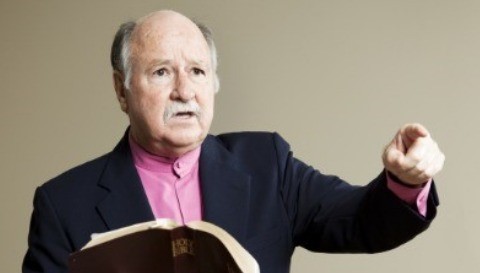
Standing Up to a Prophet of Doom
The evangelical street preacher stood in the middle of the UCLA campus and attracted a large crowd by spewing insults at ethnic groups and minorities.
This “Prophet of Doom” accused professors, blacks, Hispanics, and other minorities of being “non-believers” who were condemned to hell and eternal damnation.
The students rowdily jeered and heckled the preacher in an attempt to drown out his hate-filled speech.
I witnessed this spectacle together with members of the Jewish Student Union who had joined me in distributing Jewish information on campus.
As the preacher went down his list of ethnic groups to insult, he shouted out, “The Jews killed Jesus and are damned to hell.” Upon hearing these horrific words, one Jewish student began to cry. She turned to me and said, “Rabbi, please stand up to this bigot and defend Jews and Judaism.”
I quickly moved to the middle of the crowd and challenged the preacher. In my loudest voice, I demanded proof that Jesus was the messiah. He dismissively answered, “Who else could perform miracles and heal the sick?”
In response, I pointed out numerous contradictions between the New Testament and the Jewish Bible, and I asserted that these contradictions dispute the credibility of the account of Jesus’ life and his so-called miracles.
If that wasn’t enough, I insisted that performing “miracles” does not prove that someone is a prophet or a messiah. This statement is true because the Torah teaches that even magicians, like those in Egypt, can manipulate nature, and false prophets can provide signs or wonders to test our faithfulness to God.
The source for this powerful refutation to missionaries is found in this week’s Torah portion, Re’eh (Deuteronomy 11:26–16:17). Deuteronomy Chapter 13 begins with a proclamation that we should keep God’s commandments and not add to or subtract from them. Chapter 13 of Deuteronomy continues:
If there arises among you a prophet or a dreamer of dreams and he gives you a sign or a wonder, and the sign or wonder happens, which he spoke saying, “Let us follow other gods which you have not known and let us serve them,” you shall not listen to the words of that prophet or dreamer of dreams.
For the Lord, your God, is testing you, to know if you love the Lord, your God, with all your heart and with all your soul. It is the Lord, your God, you must follow and revere. Keep His commands and obey Him… And that prophet or dreamer of dreams shall be put to death (Deuteronomy 13:2-6).
These verses provide several valuable lessons. First of all, performing miracles does not prove that someone is a prophet, and secondly, following the commandments is the ultimate demonstration of loyalty to God.
Therefore, it comes as no surprise that King Solomon sums up Judaism with these stirring and definitive words, “The end of the matter, when everything has been heard, is to fear [be in awe of] God and keep His commandments, because this is the whole duty of man” (Ecclesiastes 12:13).
There are Christians who believe Jesus abolished the commandments. This claim not only contradicts Solomon’s words but also violates the message of Deuteronomy 13, which emphasizes that we should keep the commandments and not add to or subtract from them.
Keeping the commandments is so essential to Judaism that it is highlighted and mentioned repeatedly in the bible and Deuteronomy 13. To avoid drawing attention to the commandments, most Christian bibles move the first verse of Deuteronomy 13, which states, “Everything that I command you, you shall be careful to do. You shall not add to it or take from it,” and put it at the end of Chapter 12. Both the context and the layout of the most ancient manuscripts refutes this intentional rearrangement of the text.
Indisputably, Deuteronomy 13 declares that the ultimate proof that someone is a messenger of God is not his miracles, but his loyalty to the Torah and the commandments.
It is true that in extenuating circumstances, Elijah the prophet, in I Kings 18:22-38, performed a miracle to prove to Jewish worshipers of Baal that their belief was wrong. In addition, Elijah’s miracle made it clear that they were incorrect to assume that they could maintain a dual allegiance and be “Jews for Baal.”
Nevertheless, after this event, God taught Elijah a lesson about miracles. He was told that the effects of “miracles” wear off over time and the place to find God is not in astounding events, such as “powerful winds,” “earthquakes,” and “fires,” but in God’s words, which are referred to as “a small, still voice” (I Kings 19:12).
Faithfulness to obeying God and following the commandments is the foundation of Judaism and the moral message we share with the nations of the world. Rather than a burden, as some claim, the commandments are a blessing and a spiritual lifeline and connection to the Almighty.
Shabbat Shalom,
Rabbi Bentzion Kravitz
© 2023 Jews for Judaism • P.O. Box 351235, Los Angeles, CA 90035 • 310-556-3344
info@JewsforJudaism.org • www.jewsforjudaism.org/donate • www.SMARTalks.com



.jpg)