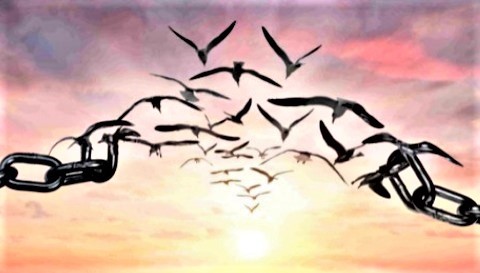
Spiritual Freedom In The Blink of an Eye
I recall the moment I heard the tragic news of President John F. Kennedy’s assassination. My initial reaction was disbelief — and then I cried.
In the blink of an eye, I was transformed from an innocent child to someone confronted with the realities of life and death.
Everyone experiences transformative moments. For some, it is the death of a parent or a friend, and for others, it is the birth of a child. These events transform us instantaneously from one reality to another.
The Jewish people experienced several transformations while in Egypt. For many years, they lived a life of freedom and plenty. Then, with the wave of a hand, a “new” Pharaoh plunged them into a life of slavery that lasted for 210 years.
Another transformative moment appears in this week’s Torah portion, Bo (Exodus 10:1–13:16). When all seemed lost, Moses appeared and led the Jews to redemption. In a split second, the Jews were transformed from slaves to God’s chosen people.
However, there is a saying, “It is easier to take the Jews out of Egypt than to take the Egypt out of the Jews.” It is one thing to free our bodies from slavery and another thing to free our minds and souls.
The Hebrew name for Egypt [מצרים–mitzrayim] is almost identical to the word meitzarim which means distress, restraints, and limitations (see the word מצר in Psalm 118:5). This teaches that Egypt represented an inescapable land with complete dominance and control over its population.
Although ancient Egypt no longer exists, our sages teach, “In every generation [and every day], a person is obligated to regard himself as if he personally left Egypt” (Mishnah Pesachim 10:5; Tanya Chapter 47). We can achieve this by transcending our personal limitations, which hamper our spiritual growth.
King Solomon provides a solution to this challenge declaring, “I saw that wisdom exceeds folly as light exceeds darkness” (Ecclesiastes 2:13). In the same way a candle immediately dispels darkness, wisdom dispels foolishness and ignorance.
Consequently, the spiritual message of true redemption from Egyptian slavery is to constantly use the wisdom in our minds, as informed by the wisdom of the Torah, to dispel the folly of our emotions. This should ultimately translate into actions that refine the world into a better place. No wonder, then, that Judaism views this process as the ultimate way to achieve spiritual freedom.
To highlight this message, the Torah connected the Exodus narrative with the commandment to wear tefillin on the head [mind] and arm [opposite the heart] (Exodus 13:9). The spiritual message of tefillin is to use our minds to control our hearts’ emotions in order to act correctly and with moral clarity.
Unlike other religions that view commandments [like tefillin] as meaningless rituals, Judaism embraces the commandments [מצוות–mitzvot] as opportunities to connect [צוותא–tzavta] to God and apply their spiritual and inspirational lessons to our lives.
During the coming messianic redemption, we will witness another transformation that will surpass the spiritual redemption from Egypt. In those days, not only will we be redeemed physically from exile; God will also transform us spiritually by removing the hold our passions have over us.
“I will give you a new heart and put a new spirit in you, I will remove your heart of stone and give you a heart of flesh, and I will put My Spirit within you and cause you to walk in My statutes and to carefully observe My ordinances” (Ezekiel 36:26-27).
The messianic age is also a time when “the earth will be filled with the knowledge of the glory of God as the waters cover the sea” (Habakkuk 2:14). This knowledge will fill our hearts and consciousness and dispel all obstacles to serving God.
This enhanced relationship with God is the meaning of the “New Covenant” spoken of in Jeremiah 31:31-32, which missionaries mistakenly claim replaced and superseded the original. However, a correct reading teaches that the initial covenant at Sinai would never be broken by God [Leviticus 26:44] but could be temporarily broken by Jewish disobedience. However, in the future — as Ezekiel stated — the Jews will keep the commandments and no longer break the covenant, because their hearts will be transformed and they will no longer have the inclination to transgress.
As incredible as this may sound, history has demonstrated that transformative events can happen when least expected. I believe this powerful message is one of the great secrets of Jewish survival. It is also why we never give up hope that darkness will be transformed to light “in the blink of an eye,” as it says, “Light will burst through like the dawn, and your healing will spring up quickly” (Isaiah 58:8; Rashi on Exodus 12:41).
Shabbat Shalom,
Rabbi Bentzion Kravitz
© 2023 Jews for Judaism • P.O. Box 351235, Los Angeles, CA 90035 • 310-556-3344
info@JewsforJudaism.org • www.jewsforjudaism.org/donate • www.SMARTalks.com


.jpg)