
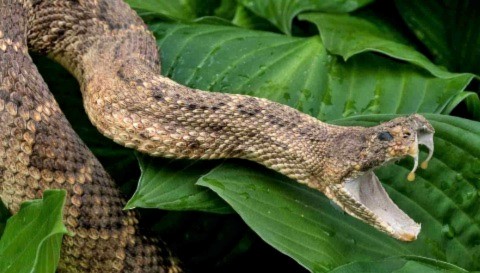
Growing up on the East Coast, I was never afraid of garden snakes, which I often discovered in my backyard. When I moved to California and started hiking in the mountains, I encountered my first rattlesnake. Although I did not panic, I was cautiously nervous.
I now have a healthy respect for these slithering creatures.
Snakes play a pivotal role in this week’s Torah portion of Chukas (Deuteronomy 19:1-22:1).
In response to the Jewish people’s discontent and complaint about the Manah food God had given them, they were stricken by venomous snakes that caused many Jews to die.
Those who had not yet succumbed to the poison confessed their transgression and asked Moses to intercede with God to be healed. God tells Moses to make a copper serpent and place it on a high pole, and that all who gaze heavenward will be healed.
This story used to confuse me. How could God, on the one hand, prohibit graven images and now request that Moses form a copper snake? This apparent contradiction provides an important spiritual lesson.
Graven images are forbidden when we adorn and worship them. In the case of the copper snake, the lesson was to recognize that graven images are powerless, and that power and healing only comes from God. Our sages discussed this point in the Talmud (Rosh Hashana 29a) in the context of another episode in Jewish history when the Jewish people battled with the Amalekites.
In that battle, Moses sat on a hill and, “whenever Moses held up his hand, Israel prevailed, and whenever he lowered his hand, Amalek prevailed” (Exodus 17:11). Our sages explain that Moses’ hands were not a magic wand or talisman. They were pointed toward heaven to remind the Jews to rely on God’s divine help. The sages (Talmud Rosh Hashanah 29a) states this as follows.
“Did the hands of Moses make the battle, or did his hands break the battle? Rather, as long as Israel gazed upward and directed their hearts to their Father in Heaven, they prevailed; but when not, they fell.”
Our sages continue to explain that similarly, the copper snake was placed on a “high pole” so that it would also serve to direct the Jews hearts to God.
“Does the serpent kill or does the serpent grant life? Rather, as long as Israel gazed upward, and subjugated their hearts to their Father in Heaven, they were healed.”
This spiritual lesson reminds us that we should always direct our prayer directly to God and not make the mistake of worshiping intermediaries. Therefore, Moses was revered but not worshiped. Moses, who was “exceedingly humble” (Numbers 12:3) only desired that the Jewish people learn from him to direct their prayers to God alone.
Misdirecting our allegiance has been a pitfall for many people. Some worshiped the sun, stars, and trees, while others worshiped human beings whom they considered God in the flesh.
Our personal relationship with our infinite God provides us with an immediate and intimate connection with the Almighty.
This Shabbos, may we be blessed to seek and find God through thoughtful prayer and meditation, as King Solomon said, “those who seek Me shall find Me” (Proverbs 8:17).
Rabbi Bentzion Kravitz

.jpg)