
The Truth About Psalms 22:17 Click to download file
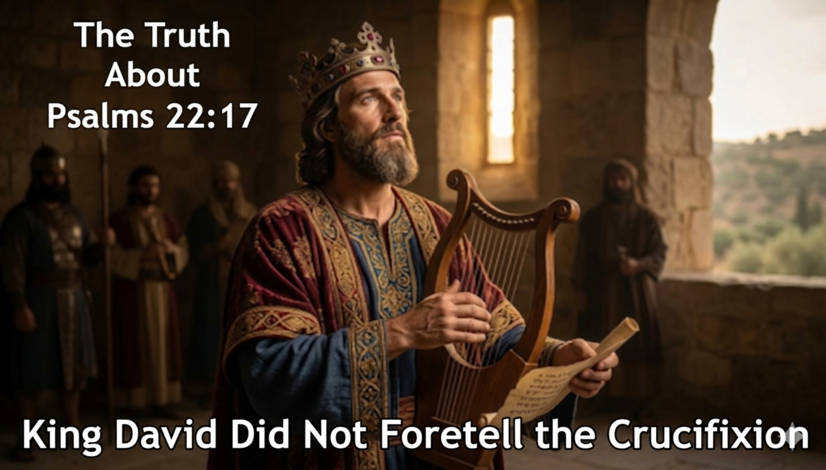
The Truth About Psalm 22
By Rabbi Bentzion Kravitz
Introduction
Christian missionaries often cite Psalms 22:17 [1] as a prophetic “proof-text” to claim that the crucifixion was foretold in the Jewish Bible known as the Tanach. The most common Christian translation of this verse reads: “Dogs have surrounded me; evil people have encompassed me; they pierced my hands and feet.”
By emphasizing the phrase “pierced my hands and feet,”they aim to evoke the imagery of the crucifixion.

Since Jesus is the most well-known figure associated with this form of execution, it is often assumed that the passage refers to him. However, this assumption fails to hold up under rigorous historical, linguistic, and contextual scrutiny.
Historical Scrutiny
Commonality of Crucifixion: Thousands of Jews and non-Jews were crucified by the Romans.
- Lack of Uniqueness: The New Testament (Luke 23:32) claims that two criminals were crucified next to Jesus; Psalms 22 could arguably be speaking about one of them or about anyone else who was crucified.
- Ambiguity: The ambiguity of this so-called prophecy undermines its validity as a proof-text. Because the act of crucifixion was not unique to a single individual, it fails to serve as a definitive proof or identifier.
- Continuity: The core of the Christian "pierced" argument is that Psalms 22 predicts the death of the Messiah by crucifixion. However, this Psalm does not end in death; it ends in a vibrant life of thanksgiving.
Context and Translation
Reading an isolated passage from the Bible usually leaves it open to misinterpretation. For example, in Luke 14:26, Jesus says: “If anyone comes to me and does not hate his own father and mother... he cannot be my disciple.” At first glance, this seems to require Jesus’ followers to hate their families as a prerequisite to being accepted as his disciple.
Nevertheless, most Christians reject this literal reading, arguing the verse is being read out of context or mistranslated. Applying this same principle to Psalms 22:17, a proper understanding requires examining both the context and the correct translation.
Contextual Analysis
The Book of Psalms was authored by King David, and much of its content serves as a poetic reflection of the actual events of his life. In Psalms 22, the imagery of being "surrounded" is a direct reference to his historical struggle, particularly during the years he spent being hunted by King Saul’s army. This is seen in I Samuel 23:26, which states, “David made haste to get away for fear of Saul, for Saul and his men 'compassed' (surrounded) David and his men to take them.”
Throughout Psalm 22, David describes his enemies using consistent metaphors for animals who surround him.
- “Many bulls have surrounded me” (v. 13)
- “A tearing and roaring lion” (v. 14)
- “Dogs have surrounded me ” (v. 17)
Other examples of David using these animal metaphors include:
- Psalms 7:3: “Lest he tear my soul like a lion, rending it in pieces.”
- Psalms 10:9: “He lies in wait secretly as a lion in his den.”
- Psalms 17:12: “Like a lion that is greedy of his prey.”
- Psalms 57:5: “My soul is among lions.”
- Psalms 59:7: “They make a noise like a dog and go round about the city.”
These biblical metaphors reflect the historical reality of David being pursued by enemies whom he compares to wild animals that surrounded him.[2]
Linguistic Translation
The original Hebrew of Psalms 22:17 makes the meaning even more obvious. The focus must be on the Hebrew word כָּאֲרִי (ka’ari), which many Christian versions translate as “pierced”.

In the Hebrew text, כָּאֲרִי (ka’ari), ends with a yud (י) and begins with a chof (כ).
It translates literally as “like a lion.” The full phrase Ka’ari yadai v’raglaimeans: “Like a lion [they are at][3] my hands and my feet.”
Other biblical examples of this word include
- Isaiah 38:13: “...כָּאֲרִי (ka’ari) – like a lion, so He breaks all my bones.”
- Numbers 24:9: “He couched, he lay down כָּאֲרִי (ka’ari) – as a lion.”
- Ezekiel 22:25: “...כָּאֲרִי (ka’ari) – like a roaring lion ravening the prey.”
The bias of the "pierced" translation is revealed by the inconsistency of Christian Bibles; while they correctly render כָּאֲרִי (ka’ari) as "like a lion" in every other instance throughout the Tanach, they deviate from this literal meaning only in Psalm 22.
Consequently, according to the context and correct translation, Psalms 22:17 is unambiguous: it refers to King David being pursued by enemies whom he metaphorically compares to wild dogs and lions that surround and attack him.
Modern Scholarship
The "pierced" translation is not universally accepted within the Christian academic community. Several prominent Christian Bibles recognize the original Hebrew meaning and render the phrase as “like a lion.”
Partial List of Translations:
- New English Translation: “Like a lion they pin my hands and feet.”
- Common English Bible “They are like a lion, mauling my hands and feet.”
- Tree of Life Version: “Like a lion, they are at my hands and my feet.”
- Lexham English Bible: “Like a lion [they are at] my hands and feet.”
- Holman Christian Standard Bible: Footnotes: “or like a lion.”
Additional Refutations
The Septuagint
Some Christian polemicists argue that the Septuagint (an ancient Greek translation) used the word oryxan (“they dug”). However, most scholars believe this was either a scribal adjustment or a misunderstanding of a rare Hebrew idiom. A Greek translator may have interpreted the actionof the lion, digging its claws in, rather than translating the literal word “lion.”
Furthermore:
- Mistaken Root: In Hebrew, the word for “digging” (like a pit) is כרה (karah), as seen in Psalms 7:15. If a translator mistook ka'ari(like a lion) for a form of karah, it would be translate as “they dug.”
- Linguistic Smoothing: “They dug my hands” sounds strange in Greek, so it was eventually smoothed out into “they pierced.”
- Scope of Translation: Both the Greek Letter of Aristeas (c. 2nd Century BCE) and the Talmud (Megillah 9a), confirm that the LXX or Septuagint (attributed to “70” Jewish sages in the third-century BCE) consisted only of the Five Books of Moses. The Book of Psalms, as well as the remainder of the Tanach, was not included. Consequently, the Greek translations available today are a later rendering of uncertain origin that contain additions, contradictions, and mistranslations. They therefore lack authority and were not written by the seventy Jewish sages.
The Dead Sea Scrolls
Missionaries sometimes cite a version in the Dead Sea Scrolls (Nahal Hever) where Psalm 22 כָּאֲרִי (ka’ari) appears to have a (vav) instead of a (yud), written as כארו, which they argue means “dig.”
However:
- Linguistic Consensus: Many linguists argue כארו is still a plural form of “lion” or a grammatical variant, rather than the verb “to pierce”.
- The “Aleph” Evidence: It should be noted that the word כארוdoes not appear anywhere in the Hebrew bible and although the word for “dig” (כָּרוּ) appears in Psalms 57:7, 119:85, and Jeremiah 18:20 & 22, it never contains an aleph (א). The word in the Dead Sea scrolls retains the aleph, linking it to “lion.”
- Scribal Style: Dead Sea scrolls scribes often wrote a yud (י) in a way that made it look like a vav (ו). This is evident in other words (עַצְמ֫וֹתָ֥י and לְעֶזְרָ֥תִי) in the same Psalm 22 parchment, which unequivocally have a yud written as a vav.
Conclusion
When restored to its original Hebrew and historical context, Psalms 22:17 is unambiguous. It is not a prophecy of a future crucifixion, but King David’s poetic description of his own narrow escapes, using the metaphor of a lion attacking its prey's hands and feet.
_______________________________
[1] You may notice that Christian Bibles cite Psalms 22 verse 16. If you compare a Hebrew Bible (Tanach) to a Christian Bible, you will often find that the verse numbers don't match. The original ancient scrolls contained no chapter or verse numbers. The chapter and verse divisions used today were added by Christian scholars in the Middle Ages. Jewish scholars later adopted these for convenience, but they didn't always agree on where a verse should end.
[2] Other proposed parallels between Psalm 22 and the crucifixion do not withstand scrutiny; for example, the mention of ‘casting lots,’ which also occurs in Numbers 26:55 and Joshua 18:10, is a common practice, and in Psalm 22 it serves as a poetic device expressing the psalmist’s humiliation rather than predicting a future event.
[3] Some missionaries argue that a verb is missing. However, throughout the Hebrew Bible we see the use of a missing verb because it is assumed that the reader will understand the meaning from the context. This is called Ellipsis, which is “The omission of a word or phrase necessary for a complete syntactical construction but not necessary for understanding.”
© Copyright 2026 Jews for Judaism